
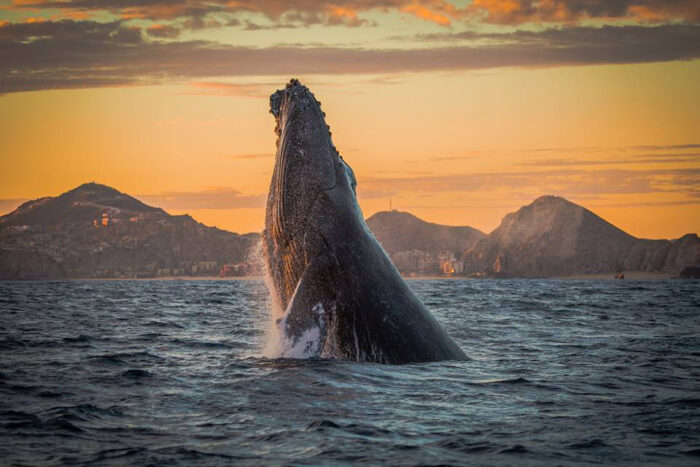
Drones, hydrophones, and less plastic: Los Cabos keys to more responsible whale tourism
In the context of World Whale Day, commemorated on February 19, Los Cabos highlights that four out of every ten visitors participate in whale watching, the second most popular activity motivating tourists to visit the destination.
With 2,131 kilometers of coastline, Baja California Sur not only boasts the greatest activity and variety of whale watching in Mexico, but it is also the first whale sanctuary in Latin America and the second in the Americas, after the United States.
According to data from the Los Cabos Tourism Trust (FITURCA), four out of every ten tourists who visit the destination participate in whale watching or swimming with dolphins and whale sharks during their stay.
Of all the tourists who visited Los Cabos in the first quarter of last year, 18%, or two out of every ten, cited whale watching and swimming with dolphins and whale sharks as their primary reason for traveling.
Whales are one of the driving forces behind the destination’s economy. In the period from January to March 2025, the 224,662 tourists who traveled to the destination for this activity generated an economic impact of 8.629 billion pesos.
Compared to 2024, the economic impact of tourists who traveled to Los Cabos primarily for whale watching increased by 59%, the average expenditure per passenger rose by 26%, and the average expenditure per stay increased by 21%, confirming the vital importance of this activity to the destination.
A Unique Legacy of Protection
According to Panorama magazine, published by the Autonomous University of Baja California Sur, Mexico pioneered whale conservation by declaring Laguna Ojo de Liebre the world’s first whale sanctuary in 1972.
At the same time, the first whale-watching tourism trips began in the United States and Mexico. Since then, this activity has only grown and, above all, evolved into a model of shared responsibility for the conservation of these mammals.
For this reason, on World Whale Day, the Los Cabos tourism ecosystem reaffirms its commitment to continue promoting collaborative actions for the care and conservation of whales, involving authorities, the private sector, and tourists.
Care on Land and Sea
Whale watching is regulated by the Mexican Official Standard NOM-131-SEMARNAT-2010, but the Los Cabos tourism ecosystem has gone further, evolving toward a zero-invasive model of shared responsibility.
The health of the ocean in Los Cabos reflects the care taken on land. The hotel sector has recognized that the preservation of the humpback whale, which finds Cabo San Lucas an ideal breeding ground, depends on the integrity of the coastline:
Zero Plastic: In compliance with current state legislation, hotels like Solaris and Solaz have eliminated single-use plastics to ensure that no land-based waste disrupts the whales’ migratory cycle or pollutes the marine ecosystem of Baja California Sur, known as the “aquarium of the world.”
Waste management: organizations like Hacienda del Mar and Kimpton Mas Olas coordinate ongoing cleanups on public and private beaches, ensuring the migratory route remains free of plastics. Others, such as Casa Dorada, have permanent responsible waste management programs.
Regenerative infrastructure: respect for the ecosystem is demonstrated in projects like La Valise, which operates entirely on solar energy, and NEST Baja, which uses advanced wastewater treatment systems to reduce pressure on natural resources.
Best practices: hotels like Chileno Bay have whale-watching stations with binoculars and maintain Blue Flag certification, awarded only to beaches that meet strict environmental criteria. Others, such as Grupo Solmar and Zadún, offer educational workshops for all ages, led by marine biologists, to raise awareness about whale conservation and the marine ecosystem. Low-impact technology: Resorts like One&Only Palmilla have incorporated technologies that allow whale watching without interference, such as the use of hydrophones to listen to the males’ songs or low-noise motors to reduce the acoustic impact on the marine ecosystem.
A new tourist profile: A believer in the shared responsibility model, Los Cabos maintains its focus on the quality of the tourist, rather than the quantity. Therefore, a large part of the ecosystem’s efforts are focused on raising tourist awareness.
“On this World Whale Day, our message is clear: the true experience is not about seeing more, but about seeing better. Investment in technology and shared responsibility ensure that the encounter with these noble giants continues to be a living legacy of Mexico for the world. The most memorable experiences are born from respect for the marine ecosystem,” stated Rodrigo Esponda Cascajares, CEO of FITURCA.
Tips for a Better Experience
Before
- Book two to three weeks in advance.
- Choose certified tour operators, which can be found at visitaloscabos.travel
During
- Remain calm and avoid unnecessary noise.
- Follow the guide’s instructions and do not throw objects into the water.
- Do not touch, feed, harass, or swim with the whales.
- Wear light clothing, biodegradable sunscreen, a hat, and bring a reusable water bottle and seasickness medication (if needed).
- Keep all trash generated during the trip.
After
- Enjoy other ecotourism activities such as snorkeling, paddleboarding, kayaking, hiking, turtle releases, birdwatching, and food tours.
- Participate in virtual reality educational sessions about the ocean.
• Share what you learned during the experience to raise awareness about whale conservation and the marine ecosystem.